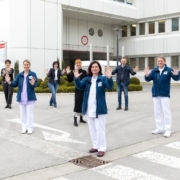
Hand Hygiene Excellence Award – Villach Hospital participates
Interview with Elke Schindler, Villach Hospital (Austria)
Villach Hospital is the first hospital in Austria to enter the Hand Hygiene Excellence Award. What motivated you to take part in the first place?
On the 12th “Day of Hygiene” in October 2018, an event of the LKH Villach, I heard a lecture by Bernhard Küenburg about the Semmelweis Foundation and the WHHEA. As a hospital that works according to the standards of the Joint Commission International, we immediately took notice. Hand hygiene has been a priority for us for a long time and we are very proud of our structures, procedures and new actions in this regard. For us, submitting to the award was an additional opportunity to create awareness for this important topic – and being among the finalists is a special appreciation for our employees who carry our hand hygiene concept with us.
What did you think about the process of the Hand Hygiene Excellence Award?
The submission process was very user-friendly and also easy because we already had the required data at our disposal – but it was very time-consuming. The visit of the expert panel led by Didier Pittet was a special highlight. We were able to present our house and could also take up a lot from the provided feedback.
Which specific policies did you submit? Which measures regarding hand hygiene have been implemented at Villach Hospital?
We have been participating in the Clean Hands Campaign for years and have implemented the guidelines as part of our hygiene and quality management strategy. A special feature of our hospital are many small, creative, and sometimes humorous activities to remind our staff of hand hygiene. E.g.: Distribution of buttons, dressing up as bacteria, use of clinic clowns, shooting a hand hygiene film, etc. The regular use of the Semmelweis box and the implementation of hand hygiene towers in the public areas are other measures we have taken.
Taking a glance at the past: How did the topic of hand hygiene and its relevance change over the course of your career as a doctor?
As an anaesthetist, I come from the operating theatre area and intensive care. Hand hygiene did always have high priority in these areas. However, hand hygiene was often treated like a stepchild in many other areas of the hospital. The fact that we now have a science-based standard system with tools for proper use in the health sector – thanks to the WHO and thanks to Didier Pittet and his colleagues – has certainly led to an enormous improvement in compliance in all professional groups, not least in the medical sector. And last but not least, the corona pandemic has contributed to hand hygiene finally getting its due.
Let’s now also take a look into the future: What other measures would you like to implement at Villach Hospital in the next few years?
We will continue to organise the “Hygiene Day” every two years, a congress with more than 400 expert participants and speakers from all over the world – last year it took place for the 13th time. We will also push our participation in the Clean Hands Campaign. And as far as measures in our hospital are concerned, we were able to take away many fun and interesting ideas from the expert panel – how we are going to implement them will be a surprise for our staff.
What advice would you give to other applicants? What should they pay attention to?
The most important thing about the application is to inspire employees to want to win the award. The submission itself helps to raise awareness of hand hygiene in your own company and should therefore be seen as a great opportunity. The submission document corresponds to the WHO Self-Assessment on Hand Hygiene and is therefore a great tool.
Directed towards the Austrian Government or other hospitals in Austria as well as in the CEE region – what other wishes do you have?
Correct hand hygiene can save lives and creating awareness among staff, patients and relatives does not have to be expensive, it often only needs a few good and simple ideas. I would like to see a lot of exchange of experiences in the health sector in the future – hand hygiene needs publicity and the corresponding framework conditions need to be consolidated or expanded.
 (c) freepik.com | user18526052
 (c) freepik
 (c) Pixabay | Mattthewafflecat